
HRTC Baggage Policy 2026 Explained: Fee Chart, Rules and Practical Tips
Himachal Road Transport Corporation has been ferrying passengers along some of the most dramatic mountain roads in the country since 1974, but it took until August 2023 for HRTC to formally introduce a separate tariff for luggage. The impact on the corporation’s books was immediate – within a month of rollout, revenue had climbed roughly 25 percent over the same period the previous year, according to a report by The Tribune. More than a year on, though, plenty of regular passengers – especially in Himachal’s more remote pockets – still aren’t entirely sure how the fee structure works.
A Real Example: My Mother’s Bus Ticket
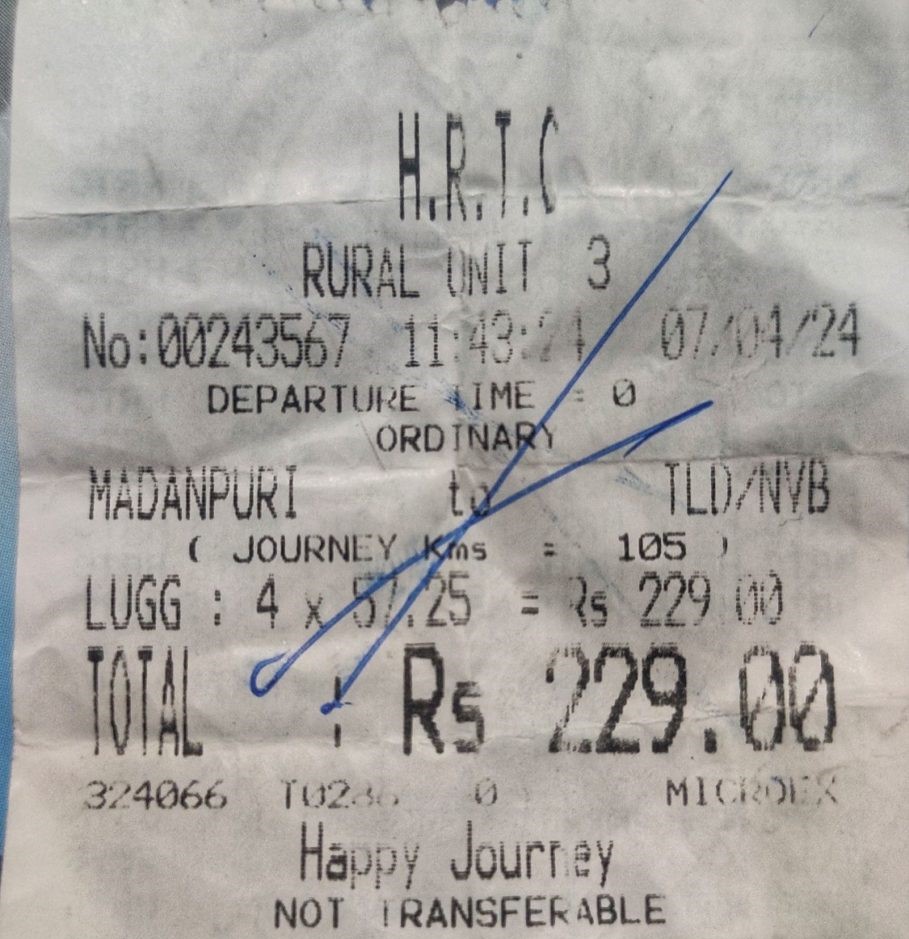
A few weeks back, my mother called to tell me she was sending across two bags packed with arbi (taro root), spinach and chives from home. I knew HRTC had rolled out a baggage policy, but neither of us could say exactly what it involved, so my advice was simple: carry some cash and settle whatever the conductor asked for.
The next morning she called again – the conductor had charged her ₹229 for the baggage. That works out to a full adult passenger fare, with none of the usual women’s or green/yellow-card concessions applied, just to move her bags from the Madanpuri stop near our village to Shimla.
The Complete HRTC Luggage Fee Chart
The table below lists the applicable charge for each item, split into two columns: one rate applies when the item travels with an accompanying passenger, and a higher rate – usually double – applies when the same item is sent unaccompanied, purely as cargo.
| # | Item | Fare (With Passenger) | Fare (Without Passenger) |
|---|---|---|---|
| 1 | Office chair / Dining chair | ¼ of one passenger fare | ½ of one passenger fare |
| 2 | Dining / Office table (up to 3 ft) | Full fare of 1 passenger | 2× full passenger fare |
| 3 | Sofa set (5-seater) | 2 passenger fares | 4 passenger fares |
| 4 | Single Sofa Chair | ½ passenger fare | 1 passenger fare |
| 5 | 3-Seater Sofa | 1 passenger fare | 2 passenger fares |
| 6 | Folding / Single Bed | ½ passenger fare | 1 passenger fare |
| 7 | Single Bed Box | 1 passenger fare | 2 passenger fares |
| 8 | Double Bed Box | 2 passenger fares | 4 passenger fares |
| 9 | Large Almirah | 2 passenger fares | 4 passenger fares |
| 10 | Medium / Small Almirah | 1 passenger fare | 2 passenger fares |
| 11 | Sewing Machine / Fan | ¼ passenger fare | ½ passenger fare |
| 12 | Plastic / Folding Chairs | 1–3: ¼ • 4–6: ½ • 7–9: ¾ • 10–12: 1 fare | 1–3: ½ • 4–6: 1 • 7–9: 1.5× • 10–12: 2 fares |
| 13 | Bicycle | ½ passenger fare | 1 passenger fare |
| 14 | Children’s Trolley / Tricycle | Free | ¼ passenger fare |
| 15 | Wheelchair | Free | ¼ passenger fare |
| 16 | Desktop Computer with Monitor | ½ passenger fare | 1 passenger fare |
| 17 | Laptop | Free up to 3; then ¼ fare per extra unit | 1 passenger fare |
| 18 | LCD/LED TV up to 21″ | ¼ passenger fare | 1 passenger fare |
| 19 | LCD/LED TV 21″–40″ | ½ passenger fare | 2 passenger fares |
| 20 | LCD/LED TV above 40″ | 1 passenger fare | 2 passenger fares |
| 21 | Washing Machine | 1 passenger fare | 2 passenger fares |
| 22 | Apple Box (Gift Pack) | 1 free; then ¼ fare per extra box | ½ passenger fare |
| 23 | Apple Box (Large) | 1 free; then ½ fare per extra box | 1 passenger fare |
| 24 | Personal / Household Luggage | Free up to 30 kg (2 bags); then ¼ fare | 1 passenger fare |
| 25 | Fruit / Vegetable Sack or Box | Up to 20kg: ¼ • 21–40kg: ½ • 41–80kg: 1 fare | Up to 20kg: ½ • 21–40kg: 1 • 41–80kg: 2 fares |
| 26 | Auto Parts / Electronics / Dry Fruits / Cosmetics / Hosiery / Medicines | Up to 5kg: 25% • 6–40kg: ½ • 41–80kg: 1 fare | Up to 5kg: 25% • 6–20kg: ½ • 21–40kg: 1 • 41–80kg: 2 fares |
| 27 | Voluminous Material | Up to 10kg: ½ • 11–20kg: 1 fare | Up to 10kg: 1 • 11–20kg: 2 fares |
| 28 | Flower Box (up to 35 kg) | 1/5 passenger fare | 1/5 passenger fare |
| 29 | Any Other Listed Item | Up to 40kg: ½ • 41–80kg: 1 fare | Up to 40kg: 1 • 41–80kg: 2 fares |
| 30 | Bird in Cage | ¼ passenger fare | Not Allowed |
| 31 | Pet Animals (Non-AC Buses Only) | 1 passenger fare | Not Allowed |
| 32 | Same-day Newspaper Bundles | Free | Free |
Unaccompanied luggage – meaning you hand it over to the conductor without travelling on that bus yourself – is charged at a higher rate in almost every category above, since HRTC treats it as cargo rather than passenger baggage.
Note: fares for item #26 (auto parts, electronics, dry fruits, cosmetics, hosiery, medicines) were revised downward by HRTC on 16 October 2024; the figures above reflect that update.
Grey Areas Travelers Still Run Into
- There’s no precise definition anywhere of what counts as “voluminous material,” which leaves plenty of room for a conductor’s judgment call.
- Apple boxes get one tariff, general fruit and vegetable sacks get another – a distinction that isn’t obviously justified and confuses a lot of first-time shippers.
- Bicycles and wheelchairs are both charged a fee, which feels counterintuitive: cycling is one of the more eco-friendly ways to get around, and it’s hard to see the logic in taxing a wheelchair at all.
The Fine Print: Policy Terms Worth Knowing
- Pets aren’t permitted on AC buses at all.
- Restricted, prohibited or banned items can’t be carried – check HRTC’s official site for the current list.
- Loading and unloading your own luggage is your responsibility, not the conductor’s.
- HRTC takes no responsibility if tax authorities seize your goods because you couldn’t produce a valid invoice or supporting document.
- Whoever is sending the luggage – passenger or otherwise – must show an Aadhaar card to the conductor before it’s loaded.
How HRTC’s Policy Compares
Andhra Pradesh state transport corporation, APSRTC, offers a useful contrast: every passenger gets 50 kg of baggage free, and anything beyond that is billed by a straightforward distance-and-weight formula. It’s one of the few state transport bodies in the country running at a genuine profit, and the simplicity of its baggage rule is arguably part of why – travellers know exactly what to expect before they even reach the counter. HRTC’s tiered, item-by-item chart raises revenue too, but a simpler slab system would go a long way toward cutting down on confusion at the boarding gate.
Planning a Winter Trip to Spiti? Know This Before You Book
If HRTC is part of how you’re getting into or out of Spiti, this baggage policy is worth reading before you pack – not after. Winter closes several private-vehicle routes into the valley, and HRTC buses (along with local shared jeeps) often become the most dependable way in and out once the passes start icing over. A few things to keep in mind if you’re booking Spiti Valley winter tour packages this season:
Pack light and pack smart – most of our winter Spiti packages already factor in HRTC’s luggage limits, so trip essentials fit within the free personal-baggage allowance without extra fees at the counter.
- If you’re carrying camera gear, laptops or other electronics for a winter Spiti trip – common for wildlife photographers joining our snow leopard tours – budget a small buffer for baggage charges under the electronics category above.
- Road and bus schedules into Spiti change quickly in winter due to snowfall; when you book with us, we track current HRTC and route conditions and adjust the itinerary in real time so you’re not stuck waiting on a closed road.
- For larger groups on our winter Spiti packages, we typically coordinate baggage and gear transport in advance so nobody’s paying surprise per-item fees mid-journey.
If you’re mapping out and want an itinerary that already accounts for bus schedules, road status and baggage logistics, reach out and we’ll build one around your dates.
Conclusion
HRTC’s baggage policy makes sense on paper – the corporation needed a new revenue stream, and luggage fees are a reasonable way to get there. Where it falls short is clarity: undefined categories, inconsistent logic between similar items, and a fee that even applies to wheelchairs all add friction for ordinary passengers. A simpler, more transparent slab system – closer to what APSRTC runs – would likely serve both HRTC’s finances and its passengers better. Until then, the safest move is to check the fee chart above before you travel, and carry a little extra cash for the conductor just in case.