Himachal Pradesh Home Stay Rules 2026: A Complete, Up-to-Date Guide
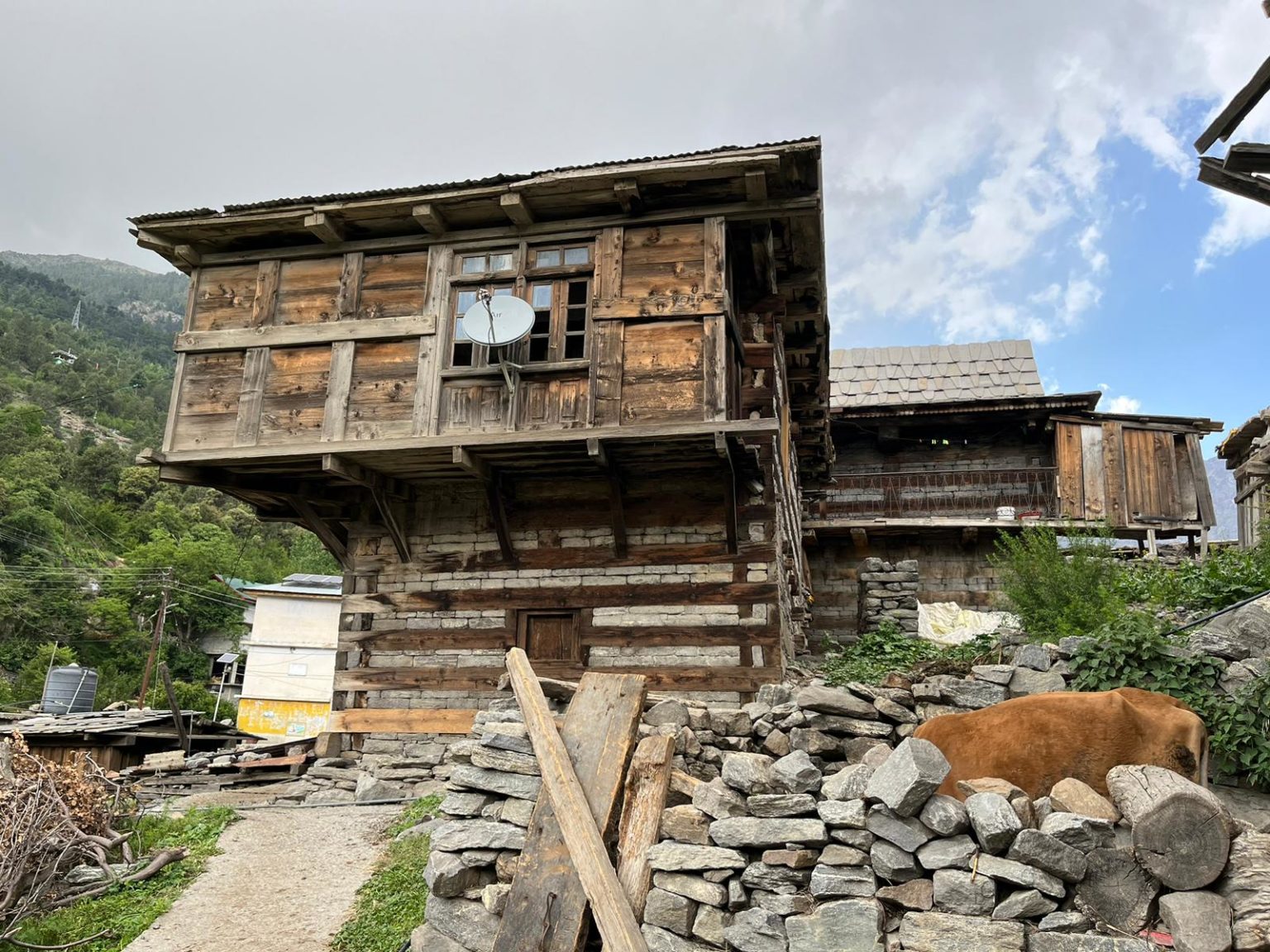
For years, the cover page of the Himachal Pradesh Home Stay Scheme 2008 showed a classic Himachali house perched beside a river — a slate roof built in the traditional Kath-kuni style, corn drying in the sun, terraced fields being harvested, and snow-capped peaks rising in the distance. That image summed up what the scheme was meant to protect: a slower, home-grown way of welcoming travellers into the hills. Almost two decades on, the state has finally rewritten the rulebook, and the new Himachal Pradesh Home Stay Rules 2026 mark the biggest shake-up the sector has seen since it began.
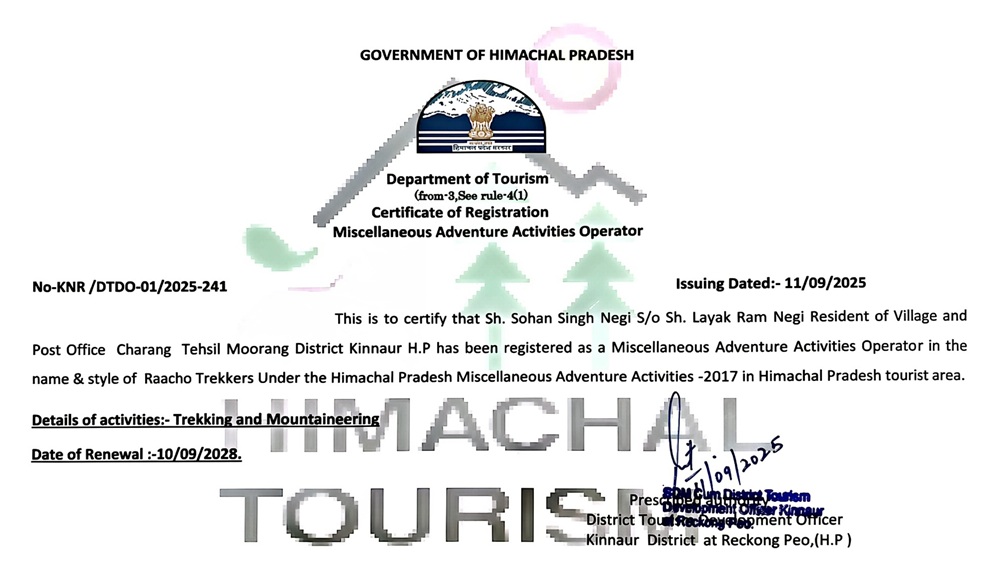
At Raacho Trekkers, we work with homestay families across Kinnaur, Spiti Valley, Uttarkashi and the Garhwal Himalaya. Almost every trip we run – from classic treks in Kinnaur to high-altitude crossings like the Lamkhaga Pass trek and Auden Col, right through to our winter Spiti trips and spiti valley snow leopard tours – depends on well-run, properly registered homestays along the route. So we have followed this policy shift closely, from the very first draft to the final notification. Here is what has changed, what it means for owners, and how it stacks up against the old rules.
How the Original 2008 Homestay Scheme Worked
The 2008 scheme was loosely modelled on the Incredible India Bed & Breakfast Scheme and was designed to spread tourism beyond crowded hubs like Shimla, Dharamshala and Manali. Only homeowners in rural Himachal Pradesh – areas outside the limits of Municipal Corporations, Nagar Parishads and Nagar Panchayats – could register.
Whatever its limitations, the scheme did open up a genuine source of self-employment with very little capital investment, and it played a real part in strengthening rural incomes even if the scale of that impact is still debated.
Registration with the Department of Tourism & Civil Aviation cost a nominal ₹100. Since 2021, applications and renewals moved to Himachal Tourism’s e-services portal – in theory a simple online process, in practice a source of constant frustration. The portal was never properly optimised for mobile phones, so uploading documents from a handset was a struggle, and even desktop users regularly dealt with slow server response times and long load delays.
Because internet connectivity in much of rural Himachal is patchy at best, most applicants ended up visiting a Lok-Mitra Kendra instead of applying from home. These centres typically charged a convenience fee of ₹200–₹300 on top of the government’s ₹100 fee. Once submitted, a Hotel Inspector from the Tourism Department would carry out a field visit, after which the report went to the District Tourism Development Officer (DTDO) for final approval.
Even with almost no state marketing push, the homestay sector grew rapidly under this light-touch system. What didn’t grow at the same pace was oversight: the Department never published the promised public list of approved homestays, and the training programmes owners were supposed to receive – meant to be delivered jointly by the Department, DTDOs and the Himachal Consultancy Organisation (HIMCON) – happened only sporadically and made little practical difference. More capable training providers, such as the Institute of Hotel Management, Kufri, were largely left out of the process.
The scheme’s own Objective 2(e) called for homestays to be ‘ecologically sustainable,’ but it never spelled out what that meant in practice or how an owner was supposed to demonstrate it. That gap between intention and enforcement is, in many ways, the story that led to the 2026 rules.
Why Regulation Became Unavoidable
The original room cap – three rooms per homestay, later raised to four – was widely ignored. Six to eight rooms became common, and in one Kinnaur case an owner was reportedly operating 16 rooms under a homestay registration. Hotel associations across the state pushed hard for the government to close this gap and level the playing field between homestays and licensed hotels.
Draft Himachal Pradesh Home Stay Rules, 2026
The draft rules were published in the state Gazette on 14 February 2026, opening a 15-day public comment window. For the first time, eligibility was proposed to extend well beyond rural Himachal, to include:
- Bonafide Himachalis who own a home anywhere in the state
- Residents who have lived in Himachal Pradesh for more than 20 years
- Individuals with a permanent home in Himachal Pradesh who currently live elsewhere for work or business
This effectively brought non-Himachalis owning flats in towns like Shimla and Dharamshala into the fold for the first time. Predictably, the draft ran into strong resistance from existing homestay owners, largely over a proposed 2,900% increase in registration and renewal fees, the addition of GST, and commercial (rather than domestic) tariffs for water and electricity.
Draft Rules 2026 – Key Provisions at a Glance
| Section | Key Provisions |
|---|---|
| Title & Scope | Himachal Pradesh Home Stay Rules, 2026 — applicable across the entire state. |
| Room Size |
• Double Room: Minimum 120 sq. ft. • Single Room: Minimum 100 sq. ft. • Attached Bathroom/Toilet: Minimum 30 sq. ft. |
| Urban Area Definition | Includes Municipal Corporations, Municipal Councils, Nagar Parishads/Panchayats, and land located within 50 metres of National Highways. |
| Eligibility | Any owner of a structurally sound home can apply online. Flats/apartments require an RWA NOC. A structural stability certificate from a registered professional is mandatory. Each unit may have 1–6 rooms (maximum 12 single beds), each with an attached toilet (rural areas may use a separate toilet). Up to 3 family suites with 4 beds each are allowed, subject to the overall 12-bed limit. |
| Registration | Applications are submitted through the Himachal Tourism e-Services Portal. Site inspections verify facilities, hygiene, and safety. Registration certificates are issued for 1 year or 3 years. Existing homestays under previous schemes must re-register within 30 days. Registration is compulsory before operations begin. Applications are processed within 60 days, excluding applicant correction time. |
| Registration Fees |
4–6 Rooms • Municipal Corporation: ₹12,000/year • TCP/SADA/NP Area: ₹8,000/year • Gram Panchayat: ₹6,000/year 1–3 Rooms • Municipal Corporation: ₹8,000/year • TCP/SADA/NP Area: ₹5,000/year • Gram Panchayat: ₹3,000/year Renewal charges remain the same, with a 10% discount for 3-year payment and an additional 5% discount for women owners. |
| Renewal | Renew every 1 or 3 years through the e-Services Portal by submitting the previous certificate and renewal fee. Future renewal policies may also consider online ratings and customer reviews. |
| Other Provisions | Rural homestays may use separate (non-attached) toilets. Homestays already registered under Central or State schemes retain their validity without additional fees until expiry. Local authorities must maintain a Homestay Register. Family suites remain limited to 3 suites of 4 beds, within the overall 12-bed cap. |
The Final Himachal Pradesh Home Stay Rules, 2026
The notified rules settled on three homestay categories – Diamond, Gold and Silver – each tied to the tariff charged per room, with its own registration and renewal fee structure.
| Category | Tariff (Per Room / Day) | Fee – MC Area | Fee – TCP / SADA / NP | Fee – Gram Panchayat | Renewal Fee |
|---|---|---|---|---|---|
| Diamond | ₹10,000 and Above | ₹18,000 | ₹12,000 | ₹10,000 | Same as Registration |
| Gold | ₹3,000 – ₹10,000 | ₹12,000 | ₹8,000 | ₹6,000 | Same as Registration |
| Silver | Up to ₹3,000 | ₹8,000 | ₹5,000 | ₹3,000 | Same as Registration |
- TCP = Town & Country Planning area
- SADA = Special Area Development Authority
- NP = Nagar Panchayat/Parishad area
- GSTIN registration is compulsory for both Gold and Diamond category homestays
- Gold and Diamond category homestays are billed at commercial electricity and water tariffs
- A homeowner can apply under any category, but the concerned DTDO or Department official ultimately decides the final category, based on facilities, furnishing, location, hygiene, cleanliness, and safety features
- Registration or renewal can run for 1 year or up to 3 years, with a 10% discount for opting into the 3-year term
- Women applicants get a 15% discount on registration and renewal fees
- Homestays in the Pangi region of Chamba district pay only 50% of the standard fee listed above
- Owners are not required to personally reside in the registered building – but this is not a licence to lease the property out to a third party
- Every homestay must install a fire extinguisher and a CCTV camera covering common areas such as the entry, exit, lift and lobby
- In addition to MC, Nagar Parishad and Nagar Panchayat limits, any land within 50 metres of a National Highway or a four-lane highway is also treated as an Urban Area
There is an odd internal contradiction worth flagging: Section 8(4) states that ‘the owner may charge the rates as may be appropriate but shall not be exorbitant,’ which sits awkwardly against the fixed tariff bands defined for the Diamond, Gold and Silver categories.
2008 Scheme vs. Draft Rules vs. Final Rules 2026 – Side-by-Side Comparison
| Criteria | Homestay Policy 2008 | Draft Rules (Feb 2026) | Final Rules 2026 |
|---|---|---|---|
| Scope | Rural areas only | Rural & Urban | Rural & Urban |
| Room Limit | Maximum 4 rooms | Maximum 6 rooms / 12 beds | Same as Draft Rules |
| Minimum Floor Area |
Double: 120 sq.ft. Single: 100 sq.ft. Toilet: 30 sq.ft. |
Same as 2008 Policy |
New Buildings: Same as 2008. Old Buildings: Double: 100 sq.ft. Single: 80 sq.ft. Toilet: 25 sq.ft. |
| Tariff Limit | ₹2,500 | No Limit | No Limit |
| Owner Residency | Mandatory | Not Mandatory | Not Mandatory |
| Flat Owners Eligible | No | Yes | No |
| Registration Fee | ₹100 | ₹3,000 – ₹12,000 | ₹3,000 – ₹18,000 |
| Categories | None | Based on Room Slabs | Diamond, Gold & Silver (Based on Tariff) |
| Owner Training | Optional | Not Included | Not Included |
| Utility Incentives | Domestic Rates for All | Domestic Rates for Silver Category Only | Retained from Draft Rules |
| Safety & Hygiene Standards | Minimal | Checklist Added (Fire Safety, RO Water, CCTV) | Retained |
| Police Verification / Panchayat NOC | Not Required | Required | Not Required |
| Penalties / De-registration | Light | Stronger – Inspections & Seizures | Retained |
| Attached Toilet Requirement | Mandatory | Mandatory in Urban Zones | Retained |
What’s Genuinely Good About the 2026 Rules
- A clear minimum-standards checklist that should raise the guest experience across the board – cleanliness, fire safety and general hygiene
- A 15% fee discount for women owners, which should encourage more women to formally enter the tourism economy
- The rules now sit under the Himachal Pradesh Tourism Development and Registration Act, 2002, bringing real legal accountability that the 2008 scheme never had
- Mandatory CCTV and fire extinguishers meaningfully improve safety for both guests and property owners
- Owners currently registered under the Incredible India Bed & Breakfast scheme must now migrate to these new rules, closing an old loophole
Where the Rules Still Fall Short
- Making owner residency optional could hurt guest experience and accountability, particularly in more remote areas where the owner previously acted as an on-site host
- There is still no formal training requirement in hospitality, hygiene or guest service
- Sustainable practices – solar power, greywater reuse, eco-construction, cutting down on plastic – remain suggestions rather than requirements
- No environmental or social impact assessment is required, despite how quickly the homestay sector has expanded
- There’s still no system for tracking tourist footfall, waste generation, or seasonal strain on infrastructure
- Steep registration and renewal fees may discourage smaller owners from registering at all, pushing some homestays back into the informal, unregulated market
How to Register: The New Homestay Portal
The new homestay registration portal is now live. It was officially launched on 3 February 2026, more than seven months later than originally planned. The older e-services platform, which dated back to the 2008 scheme, was taken offline in the last week of June 2025, leaving a gap during which owners had no functioning way to register or renew online.
Owners can now apply and manage their homestay registration through the new portal using their HimAccess login credentials.
Why This Also Matters If You’re Planning a Trek or a Winter Trip
If you’re travelling through the region rather than running a homestay yourself, these rules still shape your trip in ways worth knowing about. Most treks in Kinnaur – and the remote crossings that link Kinnaur with the Garhwal Himalaya – rely almost entirely on village homestays for overnight stays before and after the trail, since there are no hotels once you’re past the last motorable road. A better-regulated homestay network here means more consistent hygiene, safer stays, and hosts who are formally accountable rather than operating informally.
Take the Lamkhaga Pass trek, for example. A typical Lamkhaga Pass trek itinerary starts from a homestay-based village on the Kinnaur side and ends in one on the Garhwal side, so the condition and registration status of those homestays directly affects how comfortable your acclimatisation nights are. The same is true for an Auden Col trek package, where base-village homestays in Harsil and Chitkul now fall under these same registration and safety standards. If you’re comparing a Kinnaur Kailash trek cost across operators, it’s worth checking whether that cost already reflects the newer, higher homestay tariffs – some older cost sheets still price stays at pre-2025 rates, which can throw off your final budget.
The rules matter just as much in winter. A growing number of travellers now look for a dedicated winter Spiti trip rather than the standard summer circuit, and most winter Spiti packages – including spiti valley winter tour packages built around snow, frozen waterfalls and stargazing – depend on a small number of homestays that stay open through the cold months in villages like Kibber, Comic and Langza. These same villages are also where our spiti valley snow leopard tours and snow leopard expedition spiti itineraries are based, since winter is exactly when snow leopard sightings in the upper Spiti and Kibber Wildlife Sanctuary are at their best. A well-run, properly registered homestay isn’t a minor detail on these trips – at 13,000+ feet in January, it’s often the difference between a safe, warm night and a genuinely difficult one.
Final Word
The Himachal Pradesh Home Stay Rules 2026 are a mixed bag – a genuine step toward accountability and safety standards, undercut by steep fees, no residency requirement, and no real push toward sustainability. For owners, the priority now is simple: register on the new HimAccess-linked portal, understand which category (Diamond, Gold or Silver) your property will likely fall under, and budget for the new fee structure well in advance. For travellers, it’s worth choosing hosts who are properly registered under the new rules – whether you’re mapping out a Lamkhaga Pass trek itinerary, pricing a Kinnaur Kailash trek, booking an Auden Col trek package, or planning a winter Spiti trip built around a spiti valley snow leopard tour.